House of AAKAASHI
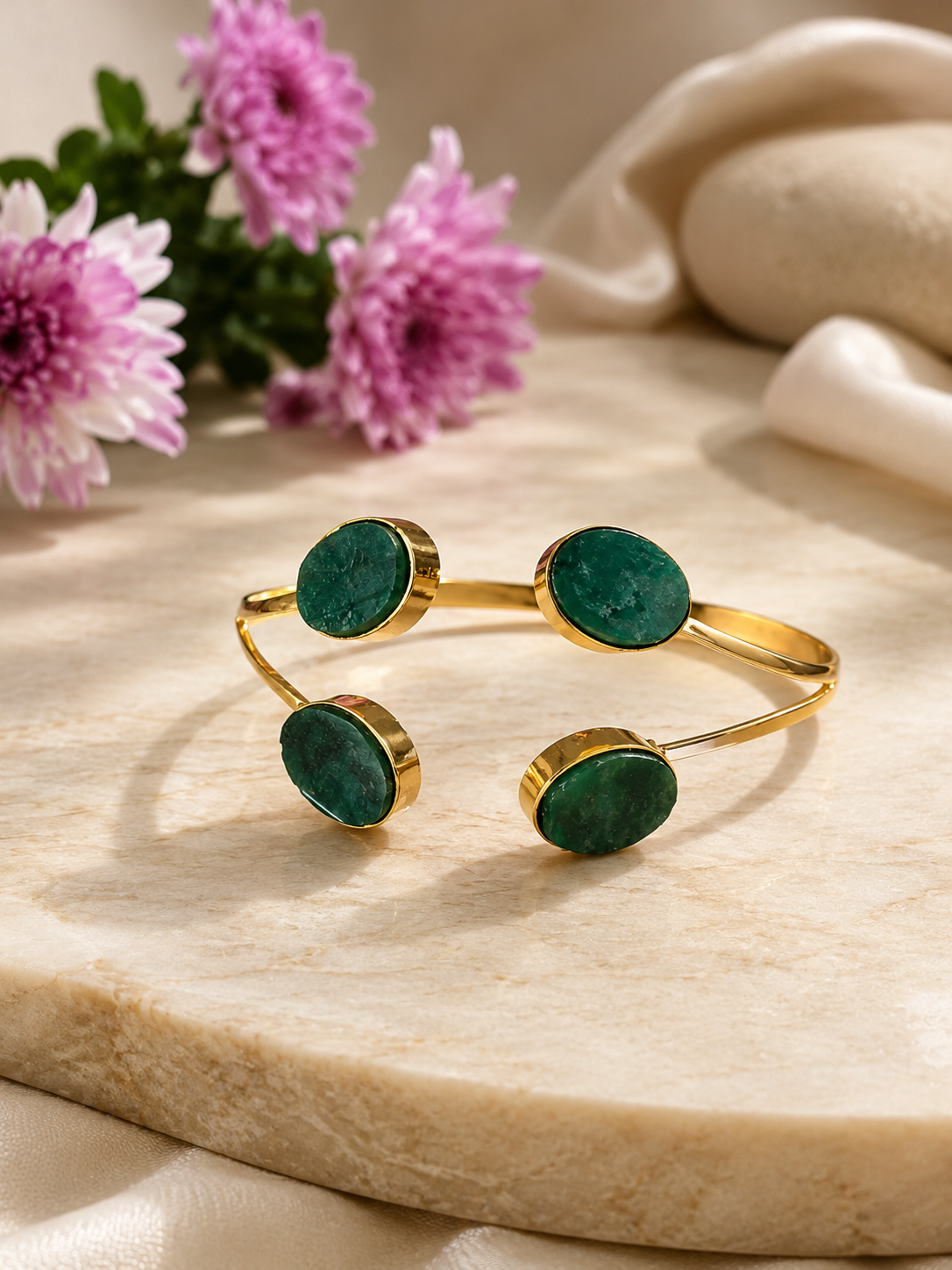
Samridhi Green Jade Four Stone Cuff Bracelet | 18K Gold Plated | House of AAKAASHI
Samridhi Green Jade Four Stone Cuff Bracelet | 18K Gold Plated | House of AAKAASHI
Couldn't load pickup availability
The Samridhi cuff is built around four deep forest-green oval Jade stones — each one dense in colour, with the natural texture and subtle variation that only real stone carries. Set in 18K gold-plated bezels along an open cuff, the pairing of rich green and warm gold is one that has appeared in jewellery across cultures for thousands of years. It looks expensive because the materials are.
The adjustable silhouette fits most wrist sizes and stacks well with simpler gold pieces. Solid enough to wear as a standalone statement, clean enough to layer without crowding. Works just as well with everyday wear as it does for festive occasions. A straightforward piece made from a stone with a very long history.
PRODUCT DETAILS
Stone: Green Jade
Stone Shape: Oval Cabochon
Product Type: Cuff Bracelet
Metal: Brass
Plating: 18K Gold Plated
Skin Friendly: Hypoallergenic, Nickel-Free
Designed For: Women
Brand: House of AAKAASHI
ABOUT GREEN JADE
Few stones have held as much cultural weight for as long as Jade. Across East Asia, Mesoamerica, and South Asia, it was not simply a decorative material — it was currency, ritual object, royal insignia, and sacred gift, often valued above gold itself.
Jade refers to two distinct minerals: Nephrite and Jadeite. Nephrite, the older of the two in terms of human use, has been carved and worn in China for over 7,000 years. Jadeite — rarer, harder, and more intensely coloured — was highly prized by the Maya and Aztec civilisations of Mesoamerica, where green Jade outranked gold as the most valuable material a person could possess. Both varieties carry the Jade name, and both share a deep green association with life, nature, and prosperity across the cultures that worked with them.
In Chinese tradition, Jade is inseparable from the concept of virtue. Confucius is recorded as having described Jade's qualities as a map of human virtues — its smoothness representing benevolence, its hardness representing wisdom, its edges representing courage. The Chinese word for Jade, yù, appears in over 500 compound words in Mandarin — covering everything from beauty and grace to moral uprightness. Jade burial suits were crafted for Han Dynasty emperors, the stone believed to protect the body and preserve the spirit after death. In feng shui practice, Green Jade placed in the home or worn on the body is traditionally associated with attracting prosperity, protecting the family, and bringing long life.
In Mesoamerican tradition, the Maya carved Jade into death masks, offering bowls, and royal pendants. Green was the colour of the maize god, of rain, and of renewal — Jade was the physical embodiment of all three. In New Zealand, Māori culture holds Pounamu (greenstone, a form of Nephrite) as one of the most sacred materials in their tradition, passed down through generations as taonga — treasured heirlooms.
In India, Jade has been used in Mughal jewellery and is associated with luck, protection, and the heart. It appears in the decorative arts of the subcontinent as a symbol of nobility and natural abundance.
Today, Green Jade is worn by people who want a stone with genuine depth — visually and historically. It is associated with steady growth, good fortune, and the kind of quiet confidence that does not need to prove itself.
CRYSTAL PROPERTIES
- One of the most historically significant prosperity stones across multiple cultures — traditionally associated with good fortune, abundance, and long life
- Linked in Chinese tradition to virtue, wisdom, and moral strength — worn and gifted as a symbol of integrity and nobility
- Associated with the heart chakra and traditionally believed to support emotional balance, generosity, and healthy relationships
- Carried and worn in many traditions as a protective stone — believed to guard the wearer and their household from misfortune
- Connected to growth and renewal — the deep green colour has represented life, nature, and fresh beginnings across East Asian and Mesoamerican cultures for millennia
CARE INSTRUCTIONS
- Remove before bathing, swimming, or using perfume and lotions — prolonged moisture and chemicals can affect the gold plating
- Store in a soft pouch or lined box away from harder stones to avoid surface scratches
- Wipe after each wear with a dry, soft cloth to keep the stone's natural sheen intact
- Avoid sharp impacts — while Jade is tough, it can chip if knocked against hard surfaces at the wrong angle
- To cleanse energetically, place under moonlight overnight or near a selenite plate — avoid salt water, which can damage both the stone surface and the gold plating over time