House of AAKAASHI
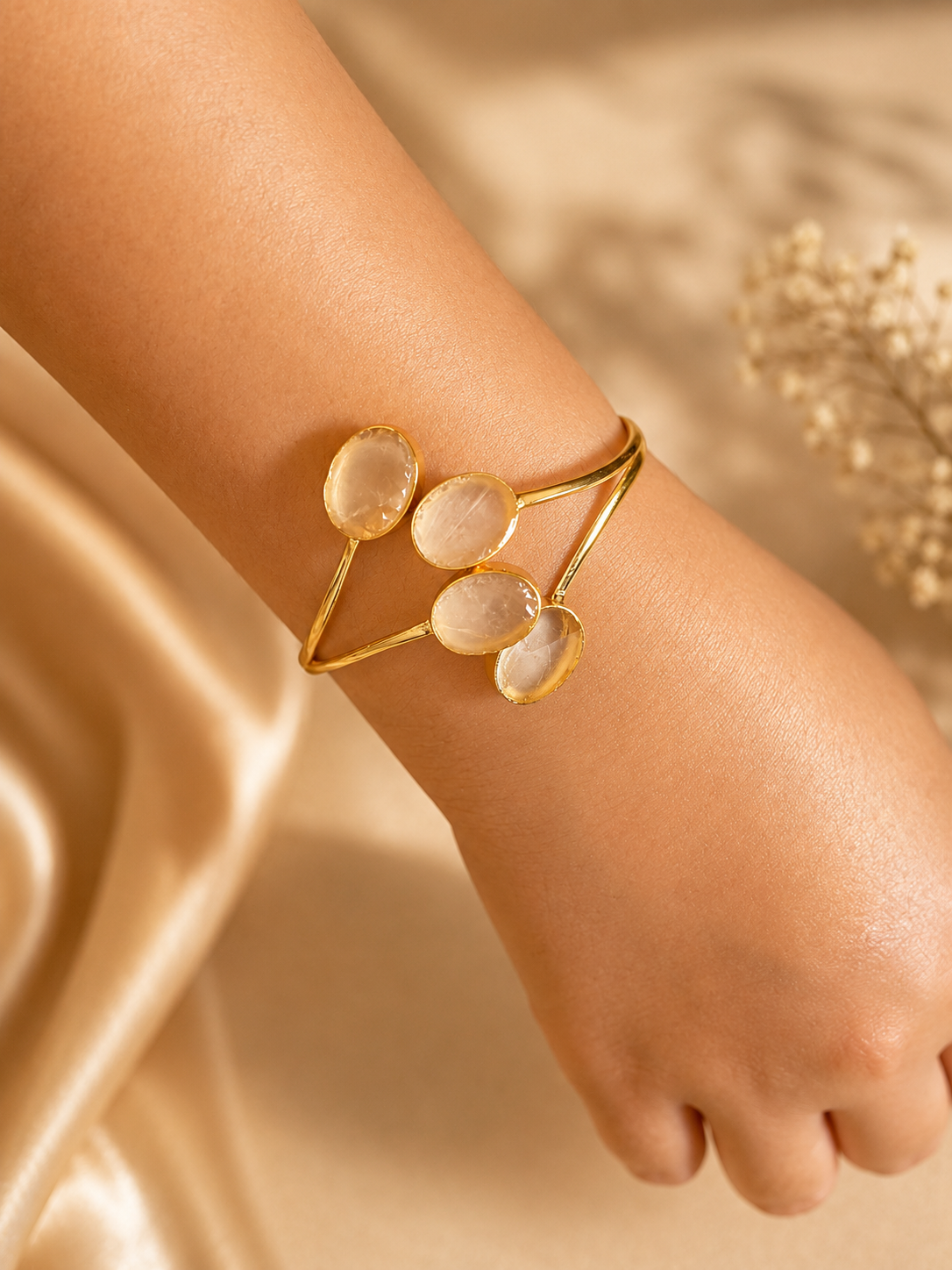
Barkat Citrine Four Stone Cuff Bracelet | 18K Gold Plated | House of AAKAASHI
Barkat Citrine Four Stone Cuff Bracelet | 18K Gold Plated | House of AAKAASHI
Couldn't load pickup availability
Warm, golden, and unapologetically luminous the Barkat cuff is built around four generously sized oval Citrine stones, each set in a deep 18K gold-plated bezel that frames their natural honey-to-champagne warmth. The open cuff silhouette is bold without being heavy, designed to sit at the wrist with quiet confidence and catch light the way only natural gemstones can.
Crafted in gold-plated brass and finished to a high polish, the Barkat is as well-suited to a linen kurta on a slow Sunday as it is to a silk sari at a festive gathering. The adjustable band accommodates most wrist sizes and stacks effortlessly with finer pieces though it holds its own worn alone. For women who are drawn to warmth in all its forms: colour, presence, and intention.
PRODUCT DETAILS
Stone: Citrine
Stone Shape: Oval Cabochon
Product Type: Cuff Bracelet
Metal: Brass
Plating: 18K Gold Plated
Skin Friendly: Hypoallergenic, Nickel-Free
Designed For: Women
Brand: House of AAKAASHI
ABOUT CITRINE
There is a reason Citrine has been called the "Merchant's Stone" for centuries — not as a poetic flourish, but as a lived practice. Shopkeepers across medieval Europe kept a piece in their cash registers. Traders along ancient Silk Road routes carried it as a pocket talisman. The stone's association with prosperity, circulation of wealth, and the courage to receive good fortune is one of the most consistent threads in global gemstone lore, crossing cultures and continents with remarkable consistency.
Citrine is a variety of quartz, ranging in colour from the palest lemon to a deep, saturated amber. Natural Citrine — the kind formed over millennia through geological heat — is relatively rare. The finest specimens have historically been sourced from Brazil, particularly the Rio Grande do Sul region, as well as Madagascar, Russia's Ural Mountains, and parts of Spain. The stone gets its name from the Latin citrina, meaning yellow, and the French citron — a lineage that speaks to how immediately recognisable and valued its colour has always been.
Ancient Greeks carved intaglio designs into Citrine as early as 300 BCE. In the Hellenistic world, it was prized as a decorative stone and set into elaborate gold jewellery — a pairing that has, evidently, stood the test of time. Scottish men in the 17th century set Citrine into the handles of daggers and sword hilts, believing the stone conferred protection and strength in conflict. Queen Victoria, famously fond of Scottish gemstone traditions, helped spark a European revival of Citrine jewellery in the 19th century that brought it firmly into the luxury tier.
In Vedic tradition, Citrine is associated with Surya — the solar deity — and is believed to carry the energy of sunlight: clarity, vitality, and the dissolution of stagnant or heavy energies. It is linked to the Manipura chakra, the solar plexus centre, traditionally associated with personal power, self-worth, and the capacity to act with intention. Unlike many stones in crystal tradition, Citrine is notably associated with not absorbing negative energy but rather dissipating it — making it unusual in its characterisation as a stone that does not require regular energetic cleansing.
Today, Citrine is worn by women who are building something — a business, a creative practice, a life that reflects their values — and who want a daily reminder of their own agency and capacity. Its warmth is visual and symbolic at once. Set four times over in the Barkat cuff, it becomes a statement not of excess but of intention: abundance, welcomed and worn with grace.
CRYSTAL PROPERTIES
- Traditionally associated with prosperity, abundance, and the attraction of positive opportunities — long used as a talisman by merchants and entrepreneurs across cultures
- Linked in Vedic and yogic traditions to the solar plexus chakra, and believed to support confidence, personal power, and clarity of will
- Considered in many traditions to be a stone of positivity that dissipates rather than absorbs heavy energy — one of few crystals not traditionally requiring energetic cleansing
- Associated with creative motivation and the sustained energy needed to see intentions through to completion
- Historically connected to solar energy and warmth, and traditionally worn to invite vitality, optimism, and forward momentum
CARE INSTRUCTIONS
- Remove before swimming, bathing, or applying perfume and skincare — moisture and chemicals may affect the gold plating over time
- Store in a soft pouch or lined jewellery box, away from harder stones that may scratch the Citrine surface
- Wipe after each wear with a dry, soft cloth to preserve the finish and the stone's natural lustre
- Avoid prolonged exposure to direct sunlight — extended UV exposure can gradually lighten the natural colour of Citrine
- To energetically cleanse, place the bracelet on a selenite charging plate or in the light of a full moon overnight; avoid salt-water cleansing methods, which may damage both stone and plating